
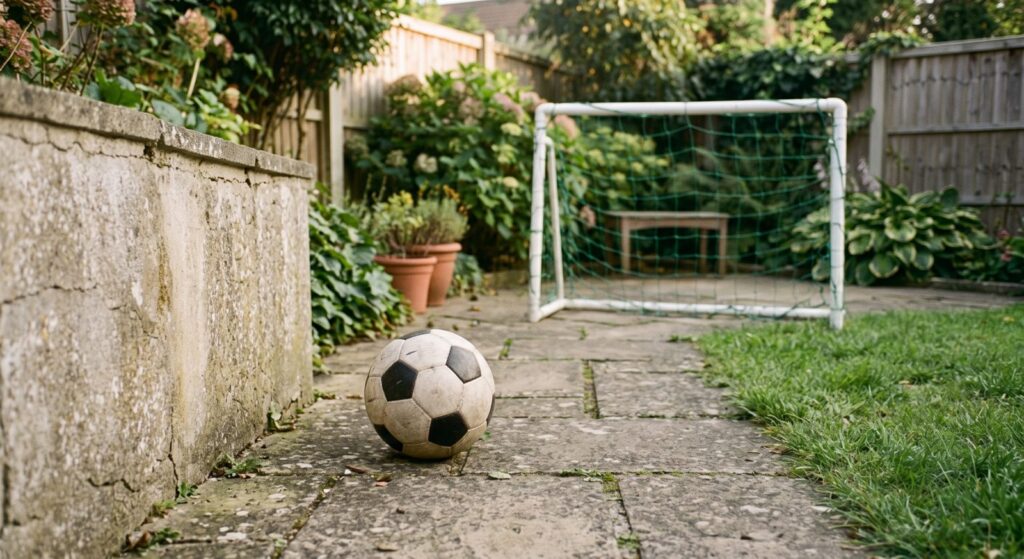
I usually train on a full field, but not every session works out that way. On the days I can’t get to one, my backyard patio has actually become a solid place to work on touch, control, and ball mastery. You don’t need much space for most of these — just a ball and a bit of patience.
What You’ll Need
A soccer ball (a lighter or futsal ball works well in a small space), a few markers — old shoes, water bottles, or small cones, a wall or fence, if you have one nearby, and about 20-30 minutes.
Warm-Up (2-3 minutes)
Before touching the ball, get your body moving: two-foot hops over a line for 30 seconds, lateral shuffles between two points for 30 seconds, and a single-leg balance hold for 15 seconds on each leg.
1. Toe Taps
Keep the ball still and tap the top of it with alternating feet, as fast as you can. If you already have some technique, you can do this quickly — but it’s a drill where a lack of technique shows immediately. If it feels slow and clunky at first, that’s normal; speed comes with repetition.
2. Foundation Taps
Similar to toe taps, but using the sole of your foot to tap the ball gently side to side instead of on top. Same idea: it rewards good technique and exposes bad habits fast. It looks like a small movement, but keeping the ball under control while going fast is what actually separates a clean set from a messy one.
3. Inside-Outside Dribbling
Move the ball using the inside and outside of the same foot, inside a small square (2×2 meters is enough). This one is harder than it looks — in a tight space, you have to concentrate on clean touches and staying inside your boundaries at the same time. It’s an easy drill to rush and get sloppy. Slow it down before you speed it up: if you can’t keep the ball inside the square at half speed, going faster will only make it worse.
4. Fast Feet Around the Ball
Place the ball on the ground and step around it quickly in a circle — 20 seconds leading with your right foot, then 20 with your left. If you keep looking down at the ball the whole time, 20 seconds will feel long. Try picking a fixed point to look at instead of the ball, and it gets a lot more manageable.
5. Sole Rolls
Roll the ball forward and back using the sole of your foot, alternating legs. This is a good one for noticing which leg is weaker — my left is clearly behind my right on this drill, and it’s a useful way to see where you actually need the work.
6. Step-Overs
Fake stepping over the ball without touching it, alternating legs, either in place or moving forward slowly. Same pattern as sole rolls: the weaker leg lags behind, so don’t skip it just because it feels awkward.
7. Cone/Marker Dribbling
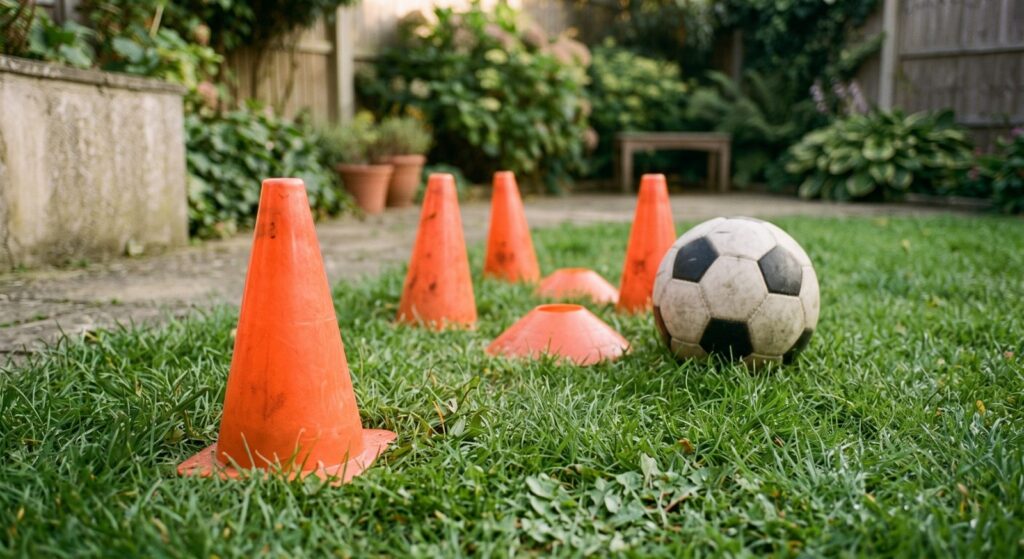
Set up 4-5 markers in a line or zigzag, spaced about half a meter apart, and dribble through them with both feet. This is one of the drills I’m most comfortable with, and it scales really well with your space — the closer together you place the markers, the harder it gets, so you can adjust it to whatever room you have.
A variation worth trying: instead of a straight line, place the markers slightly offset — one to the left, then one further forward and to the right, then back to the left again — so they form a rough Z-shape or zigzag angled forward. Dribble the ball going behind each marker rather than straight past it, weaving in and out. It forces sharper changes of direction than a simple straight line does, and it’s closer to what you actually need in a game, where you rarely turn with the ball in a perfectly straight path.
8. Juggling
Keep the ball in the air using your feet — and once you’re comfortable, add your thigh, chest, and even your head. One thing that’s helped me a lot: touch the ball gently with the top of your foot, not too hard and not too soft either — that balance is what keeps the ball under control instead of bouncing away. With practice, this adds up: I can juggle around 300 touches in a row using feet, thigh, head, and shoulder combined. That number isn’t the starting point, though — it took plenty of dropped balls to get there.
9. Wall Passing
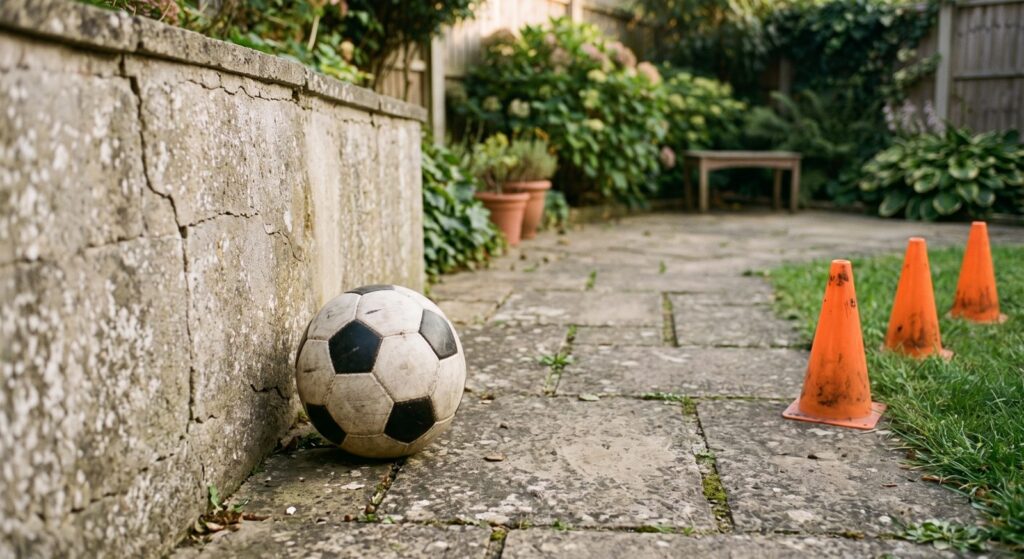
If you have a wall or fence nearby, pass the ball against it from a couple of meters away and control the rebound, alternating feet. The tricky part is controlling the bounce — it often comes back higher than expected instead of staying low, so getting a flat, controlled rebound takes some practice.
10. Vision Drill
While doing drill #3 or #7, lift your head every 2-3 touches like you’re checking for a teammate, instead of watching the ball the whole time. It adds real difficulty — controlling the ball without looking at it constantly doesn’t come naturally at first.
Common Mistakes to Avoid
Going too fast before the movement is clean. Almost every drill on this list rewards control over speed at first — add speed once the touch is solid, not before.
Only working your strong foot. It’s tempting to skip the side that feels awkward, but that’s exactly the side that needs the reps.
Watching the ball on every single touch. A few of these drills (especially #4, #7, and #10) are as much about awareness as they are about the ball itself.
A Simple Weekly Plan
Three sessions a week, 20-25 minutes each, is enough to see real progress without burning out. Here’s an example of how you could split it:
Monday — Touch and Control: Toe Taps, Foundation Taps, Sole Rolls, then finish with a Juggling set, trying to beat your previous count.
Wednesday — Dribbling: Inside-Outside Dribbling, Step-Overs, Cone/Marker Dribbling (try the zigzag variation), plus the Vision Drill on top of one of them.
Friday — Passing and Reps: Wall Passing, Fast Feet Around the Ball, and a longer Juggling set to close out the week.
Rotate the drills within each session so you’re not doing the exact same four every time.
Progressing Further
Once a drill feels easy, tighten the space, speed it up, or restrict yourself to your weaker foot only.
FAQ
How long before I notice improvement?
With three sessions a week, most people notice cleaner touches within 2-3 weeks. Things like juggling counts or clean reps on the weaker foot take longer — expect a month or more of consistent practice before that really shows.
Can I do this without cones or markers?
Yes. Toe Taps, Foundation Taps, Sole Rolls, Step-Overs, and Juggling don’t need any markers at all — they’re a solid full session on their own if that’s all the space or equipment you have.
Do I need a wall to do Wall Passing?
A fence works too, though the rebound behaves a bit differently. If you don’t have either, swap it for an extra Cone/Marker Dribbling set instead.