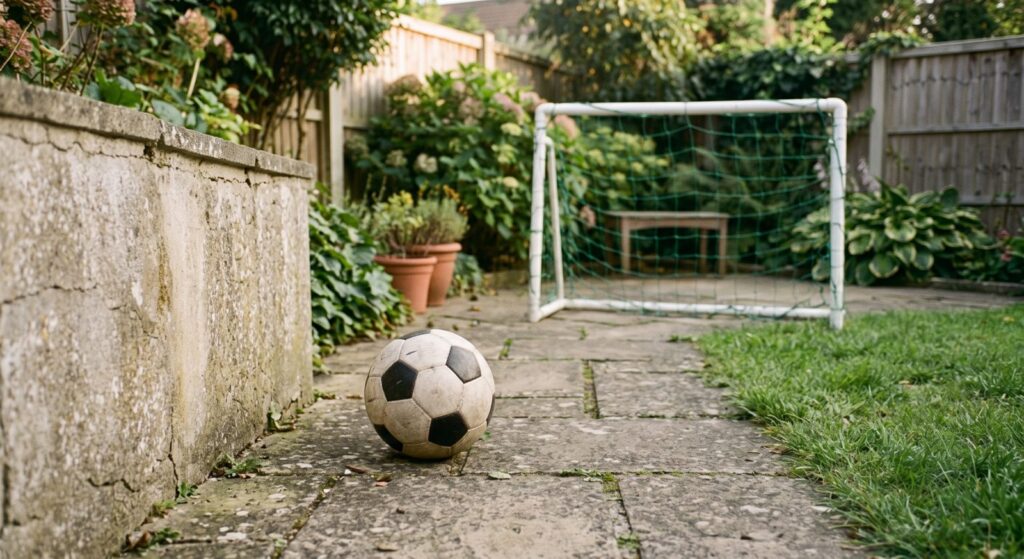

Wall passing is probably the most underrated way to train alone. It’s simple, it doesn’t need much space, and it forces you to deal with a ball that’s coming back at you fast and at unpredictable angles — which is a lot closer to a real game than most solo drills. I usually set up about 3-4 meters from the wall, which gives enough time to react to the rebound without the ball losing all its pace.
What You’ll Need
A wall or solid fence, a ball, and about 3-4 meters of open space in front of it. Flat, even ground helps, since bumpy surfaces make the rebound less predictable than it already is.
1. Finding Your Distance
Before doing anything else, spend a minute finding a distance that works for you. Too close and you won’t have time to react to the rebound; too far and you lose accuracy. For me, 3-4 meters is the sweet spot — close enough to keep a good rhythm, far enough to actually have to control the ball before passing again.
2. Basic Wall Pass (Control and Pass)
Pass the ball against the wall, take a touch to control the rebound, then pass again. Start with your inside foot — it’s the most reliable surface for both passing and control, and it’s the one to build confidence on first. Keep the passes soft here: a softer strike comes back flatter and easier to control, while a harder one comes back higher and less predictable. Get comfortable with soft, controlled passes before trying to add power.
3. First-Time Passing
Once the basic version feels easy, skip the control step and pass the ball back first-time, without letting it settle. This is noticeably harder — you have less time to adjust your body position, and any inconsistency in the rebound shows up immediately. It’s a good drill for reaction speed and for cleaning up your body shape before the ball even arrives. Once it feels comfortable, you can turn that same rebound into a shot — see how to practice shooting alone without a real goal.
4. Using Both Feet
Alternate between your right and left foot, one pass at a time. This is one of the drills where the gap between your strong and weak foot shows the most — controlling and passing cleanly with the weaker foot takes real concentration at first, while the stronger foot does it almost without thinking. Don’t skip the weak-foot reps just because they feel clumsy; that’s exactly where the improvement is.

5. Controlling High Rebounds
Hit the ball a bit harder on purpose so it comes back higher and less flat, then practice controlling it out of the air with your instep or thigh before it hits the ground. Since a harder strike naturally produces a higher, more irregular bounce, this drill uses that instead of fighting it — it’s a good way to work on cushioning a ball that’s dropping rather than rolling.
6. Mixing Control and Pass Across Feet
Once the basics feel solid, combine everything: control the ball with one foot and pass it back with the other. This forces a quick decision — where’s the ball going, which foot controls it, which foot passes it — instead of falling into a repetitive one-foot pattern. It’s a small addition, but it makes the drill feel much closer to a real passing exchange.

7. Wall-to-Wall Passing (If You Have Enclosed Walls)
If your space has walls on more than one side, like a patio boxed in on all four sides, you can use that to your advantage. Instead of always passing straight back to the same wall, pass the ball toward one wall and let it rebound at an angle toward another, then control it with an “oriented touch” — meaning you don’t just stop the ball, you control it while already turning or facing the direction you want to play next.
This is a step up from straight wall passing because you’re reacting to an angled rebound instead of a straight one, and you have to think about body orientation, not just foot contact. It’s closer to what happens in a real match, where the ball rarely comes back to you in a perfectly predictable line.
Common Mistakes to Avoid
Hitting the ball too hard too soon. A harder pass feels more “serious,” but it comes back higher and less controlled — soft and accurate beats hard and messy every time here.
Only using your strong foot. Same as with most solo drills: the foot that feels awkward is the one that needs the reps.
Standing too far or too close without adjusting. If the rebound consistently surprises you, the distance is probably off — small adjustments make a bigger difference than they seem.
A Simple Weekly Plan
Add wall passing into 3-4 of your sessions rather than doing it every day — a little variety keeps the reps from getting mechanical.
Session 1: Basic Control and Pass, both feet, focusing on soft, flat passes.
Session 2: First-Time Passing, both feet, plus a few sets of Controlling High Rebounds.
Session 3: Mixing Control and Pass Across Feet, alternating which foot does which job.
Session 4: Wall-to-Wall Passing, focusing on oriented touches — controlling the ball while turning toward your next pass instead of just stopping it dead.
Progressing Further
Once the basic version feels easy on both feet, increase the pace, mix in first-time passes randomly instead of doing them as a separate block, or move slightly closer to the wall to cut down your reaction time. If you have walls on multiple sides of your space, wall-to-wall passing is a natural next step once straight wall passing feels easy — it adds angle and direction to a drill that’s otherwise very linear.
FAQ
How hard should I hit the ball?
Start soft. A gentler pass comes back flatter and easier to control, which is what you want while you’re building the pattern. Add power gradually once your first touch is consistent.
Do I need a flat wall, or does a fence work?
A solid wall gives the most predictable rebound. A fence can work, but the bounce tends to be less consistent, so expect a bit more variation.
My weak foot is much worse at this drill than my strong foot. Is that normal?
Yes, and it’s actually one of the clearest ways to see the gap between your feet. Keep doing dedicated reps with the weaker foot rather than avoiding it — the difference closes with repetition.