
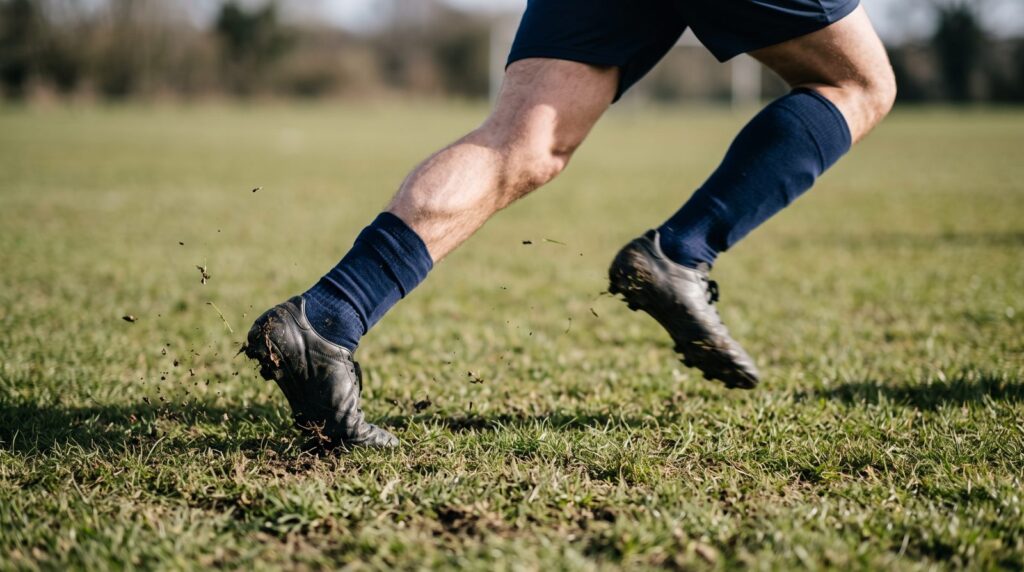
Speed in soccer isn’t really about how fast you can run 100 meters in a straight line — it’s about short, explosive bursts, changes of direction, and getting into your top gear faster than the player next to you. Most of my own speed work still comes from playing itself, but I also time myself on short sprints, usually no more than 30 meters, just to check whether I’m actually improving or just assuming I am.
Why Straight-Line Speed Isn’t the Whole Picture
A soccer field rewards acceleration and change of direction far more than it rewards flat-out top speed. Most of what you actually do in a game — closing down a player, breaking away from a defender, reacting to a loose ball — happens over short distances, not long ones. That’s why training should lean heavily toward short accelerations, changes of pace, and full turns, rather than long, straight sprints.
Train Short Accelerations, Not Just Distance
Focus your sprint work on short, sharp bursts — explosive starts over 10-20 meters, direction changes, and full turns, rather than extended straight-line runs. These mirror what actually happens in a game far better than longer sprints do. If you want a way to track progress without a coach, timing yourself over a fixed distance (I use 30 meters) every few weeks gives you an honest read on whether the work is paying off, instead of just guessing.
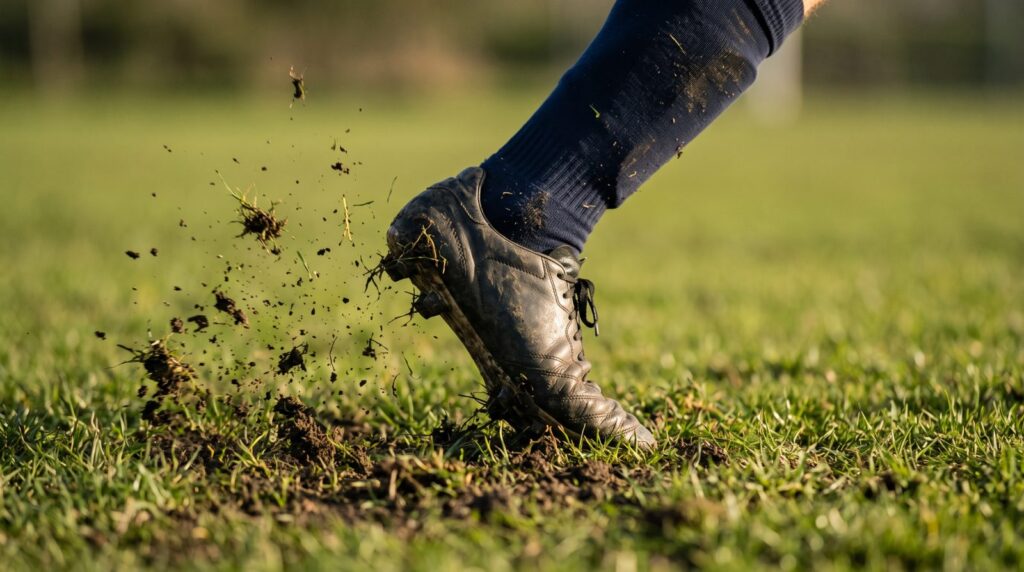
Your First Step Matters More Than Your Top Speed
In soccer, duels are rarely won by whoever is fastest overall — they’re won by whoever accelerates first. Working specifically on a more explosive first step has made a real difference for me: those first couple of strides are often the difference between winning and losing a race to the ball, even against someone who might be quicker once both players are at full speed.
Train With and Without the Ball
Speed matters in both situations, and they’re not quite the same skill. Sprinting without the ball builds raw acceleration and top speed, while sprinting with the ball trains your ability to keep that speed under control while still managing your touch. Both deserve dedicated time — being fast without the ball doesn’t automatically transfer to being fast while dribbling at pace.
A Note on Running Technique
If your speed already feels solid, there’s probably no need to overhaul your running form. But if you suspect your technique might be holding you back — awkward arm action, poor foot strike, an inefficient stride — it’s worth looking into, since cleaning up technique can unlock speed that pure repetition won’t.
Common Mistakes to Avoid
Only training long, straight sprints. Soccer rarely asks for that; short bursts and direction changes are far more useful to train.
Ignoring your first step. A better first step often matters more than a higher top speed, especially in the 1v1 duels that decide most moments in a game.
Never checking your actual times. Without some way to track progress — even informally, with a phone timer over a fixed distance — it’s easy to assume you’re improving when you’re not.
A Simple Approach to Track
Pick a fixed short distance (20-30 meters) and time yourself every few weeks, always under similar conditions, so the numbers are comparable. Mix in work on short accelerations, direction changes, and full turns rather than training only straight sprints, and include speed work both with and without the ball.
FAQ
Do I need a coach or timing gates to train speed properly?
No. A phone’s stopwatch and a consistent short distance, like 30 meters, is enough to track whether you’re actually getting faster over time.
Is it better to train speed with the ball or without it?
Both matter, and they’re different skills. Training without the ball builds raw speed and acceleration; training with it builds your ability to keep that speed while still controlling your touch.
What distance should I focus on?
Soccer rarely needs sprints longer than 30 meters in a real game — most sprints in a match are shorter than half the length of a full-size pitch. Short, sharp bursts are more useful to train than long, sustained ones.