
After 18 years of playing, you start noticing the same mistakes show up over and over, regardless of the team or the level — some technical, some tactical, some purely mental. None of them are about lacking talent; they’re habits that formed for understandable reasons and never got corrected. Here are five I see constantly, including two I had to work on myself.
1. Receiving the Ball With Your Head Down
Why it happens: control gets treated as something you do by watching the ball, so when pressure arrives, you have no idea where anyone is.
How to fix it: the habit to build is scanning — checking over your shoulder and reading the space — before the ball arrives, not after. In practice, this works well with rondos where the rule is “look before every touch,” or a drill where a teammate shouts a number or color right before passing to you, and you have to say how many defenders are behind you without looking down first.
2. Trying to Dribble or Play Alone When It’s Not the Moment
Why it happens: the urge to stand out, fear of giving a bad pass, or just believing that the good player is the one who dribbles past people.
How to fix it: limiting touches in small-sided games (two touches max) for a few weeks makes the quick, simple pass become the default instinct instead of the exception. Once that habit is in place, dribbling gets reintroduced only where it actually makes sense — the final third, or a true 1v1 with space to use.
This is one I had to work through myself. I used to go for the individual play far more than I needed to, and over time I realized the team action was almost always the better option — simpler, and the result was usually better too. More often than not, the ball would come back to me anyway, in a better position than if I’d forced something on my own.
3. Showing Up Without a Physical Base
Why it happens: playing once a week with no other training, no warm-up, and no strength work at all.
How to fix it: a 10-minute warm-up (mobility, activation, progressive sprints), one or two strength sessions a week (squats, hamstrings, core), and some interval running go a long way. It doesn’t take much — it takes consistency, not intensity.
4. Losing Shape and Crowding the Ball
Why it happens: the instinct to chase wherever the ball is, combined with most amateur teams never training positional play at all.
How to fix it: positional games with marked zones help, along with one simple rule per line — for example, “if your winger pushes forward, you cover that space.” In an actual match, having even one player who talks and organizes the shape is worth a lot.
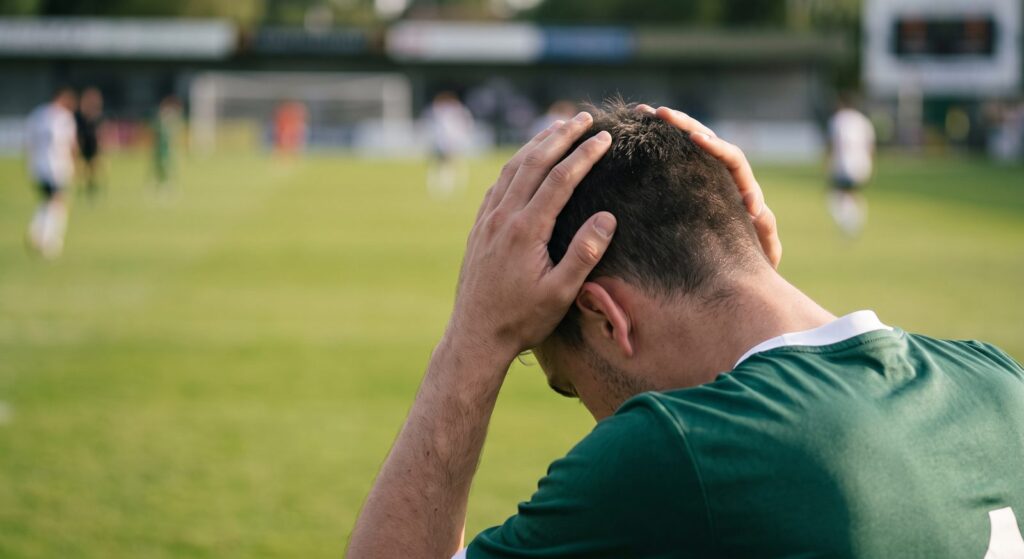
5. Mentally Checking Out After a Mistake or a Bad Call
Why it happens: amateur players are out there for enjoyment and pride, and a mistake — or a refereeing decision that feels unfair — disconnects your head for several minutes, which is exactly when the other team tends to score.
How to fix it: a short reset routine helps — a breath, a key word, the next action. In training, this can be simulated with small games where a mistake triggers a temporary numerical disadvantage, forcing a quick reaction instead of a shutdown.
This one I went through myself too. I eventually realized that staying frustrated only hurt my own game — if the referee had made a decision, there was nothing left to change about it. The only things that could happen from staying in that headspace were playing worse or picking up a card of my own. And if you do lose the ball, your teammates are always going to appreciate you sprinting back to win it more than standing still feeling sorry for yourself.
The Pattern Behind All Five
None of these are really about ability. They’re habits — formed by how most players train, or don’t train, outside of the one session or game a week. The good news is that every one of them responds to deliberate practice, not natural talent.
FAQ
Which of these mistakes is the hardest to fix?
The mental ones tend to take the longest, since they’re less about repetition and more about changing a reaction you’ve built up over years. The technical and physical habits usually show visible improvement faster with consistent practice.
Can I work on more than one of these at a time?
It’s usually better to focus on one, especially for the habits built around decision-making, like over-dribbling or losing composure. Trying to fix everything at once tends to mean nothing actually sticks.
Do these mistakes go away completely with experience?
Mostly, but not entirely — even experienced players slip back into old habits under pressure or fatigue. The goal isn’t to never make these mistakes again; it’s to catch them faster and correct course sooner.